Getting Paid in Stablecoins: What Small Businesses Should Know
How RLUSD and USDC are backed, how they settle on the XRP Ledger, and how UrsaDeFi invoices use them
By VERT (@UrsaDeFi) ·
Glossary
| Term | Meaning in this post |
|---|---|
| Stablecoin | A token designed to hold a stable value against a currency. RLUSD and USDC target the U.S. dollar. |
| RLUSD | Ripple USD, issued by Standard Custody & Trust Company, LLC, a Ripple subsidiary. |
| USDC | USD Coin, issued by Circle. |
| XRP / XRPL | XRP is the native asset of the XRP Ledger (XRPL), the public ledger UrsaDeFi settles on. XRP is not a stablecoin. |
| Reserve | The pool of cash and short-term U.S. government assets an issuer holds against tokens outstanding. |
| Attestation | An independent accountant's examination of the issuer's reserve report at stated report dates (AICPA standards). |
| AICPA / CPA | American Institute of Certified Public Accountants / Certified Public Accountant. |
| NYDFS | New York State Department of Financial Services, RLUSD's issuer's supervisor. |
| Trust line | An XRPL link a wallet must set up before it can hold a token such as RLUSD or USDC. |
| Validated ledger | An XRPL ledger version the network has agreed on; transactions in it are final. |
| Drop | The smallest unit of XRP: 0.000001 XRP. |
| IRS / Form 1099-DA | Internal Revenue Service / the form brokers use to report digital asset proceeds. |
| FMV | Fair market value, measured in U.S. dollars. |
| Xaman | The self-custody XRPL wallet app UrsaDeFi users sign in with. |
Thesis: A dollar stablecoin is only as sound as the reserve behind it and the ledger it moves on, and a small business can check both from primary sources before it accepts one as payment.
Executive summary
- RLUSD and USDC are U.S. dollar stablecoins whose issuers publish monthly independent attestations. RLUSD's reserve coverage was 105.2% as of Aug 31, 2026, per the issuer's monthly reserve report [5]; USDC's was 100.1% at the same report date [9].
- Both reserves sit in short-dated U.S. Treasuries, Treasury repo, government money market funds and bank cash. RLUSD's issuer follows an NYDFS letter that requires redemption at par within two full business days of a compliant order [7].
- On the XRP Ledger, a payment is final once it is in a validated ledger. Validators agree on a new ledger every few seconds, and a standard transaction costs 10 drops (0.00001 XRP) [14][15][16][17][18].
- To receive RLUSD or USDC on XRPL, a wallet needs a trust line for that token; each one adds 0.2 XRP to the account's XRP reserve [2][12][13].
- UrsaDeFi bills in USD, settles in RLUSD by default and accepts USDC or XRP. It marks an invoice paid automatically when it finds a matching validated XRPL transaction; you can also mark an invoice paid by hand (for example, an exchange payment sent without its tag), and the 1% fee still applies either way [1][2].
1. What RLUSD and USDC are
RLUSD. Ripple describes Ripple USD as its U.S. dollar-backed stablecoin, backed 1:1 by cash, U.S. Treasuries and government money market funds and redeemable for U.S. dollars [3]. The issuer is Standard Custody & Trust Company, LLC, a Ripple subsidiary that NYDFS charters and supervises as a limited purpose trust company [4][5]. Ripple lists seven networks for RLUSD, the XRP Ledger among them [3], and its developer documentation gives the XRPL issuer address as rMxCKbEDwqr76QuheSUMdEGf4B9xJ8m5De [6].
USDC. USDC is issued and redeemed by Circle Internet Financial, LLC and Circle Internet Financial Europe SAS [9]. Circle states that USDC is backed 100% by highly liquid cash and cash-equivalent assets and is redeemable 1:1 for U.S. dollars [8]. Circle's developer documentation lists the XRPL issuer as rGm7WCVp9gb4jZHWTEtGUr4dd74z2XuWhE [10]. Most USDC circulates elsewhere: Circle's supply feed showed about 5.75 million USDC on the XRP Ledger out of about 73.0 billion in total at 3:29 PM CT on October 10, 2026 [11].
For U.S. tax purposes, the IRS lists stablecoins as digital assets, and digital assets are treated as property, not currency [20].
Exhibit 1. RLUSD and USDC at a glance
| RLUSD | USDC | |
|---|---|---|
| Issuer | Standard Custody & Trust Company, LLC (Ripple subsidiary) [5] | Circle Internet Financial, LLC and Circle Internet Financial Europe SAS [9] |
| Regulatory detail on cited page | NYDFS-chartered limited purpose trust company [4] | Majority of reserve held in an SEC-registered 2a-7 government money market fund [8] |
| Reserve assets | Cash, U.S. Treasuries, government money market funds [3] | Cash and cash equivalents; Circle Reserve Fund (USDXX) [8] |
| Attestation cadence | Monthly, independent U.S. CPA, within 30 days of month end [4] | Monthly third-party assurance by a Big Four firm; weekly reserve disclosure [8] |
| Latest report read | August 2026, Deloitte & Touche LLP, dated Sept. 29, 2026 [5] | August 2026, Deloitte & Touche LLP, dated Sept. 29, 2026 [9] |
| XRPL issuer address | rMxCKbEDwqr76QuheSUMdEGf4B9xJ8m5De [6] | rGm7WCVp9gb4jZHWTEtGUr4dd74z2XuWhE [10] |
Source: [3] RLUSD FAQs; [4] Attestations; [5] Independent Accountant's Report; [6] For XRPL; [8] Monthly assurance, How we manage USDC; [9] Management's Assertion; [10] XRPL row. All accessed 2026-10-10.
Exhibit 2. Most USDC circulates outside the XRP Ledger
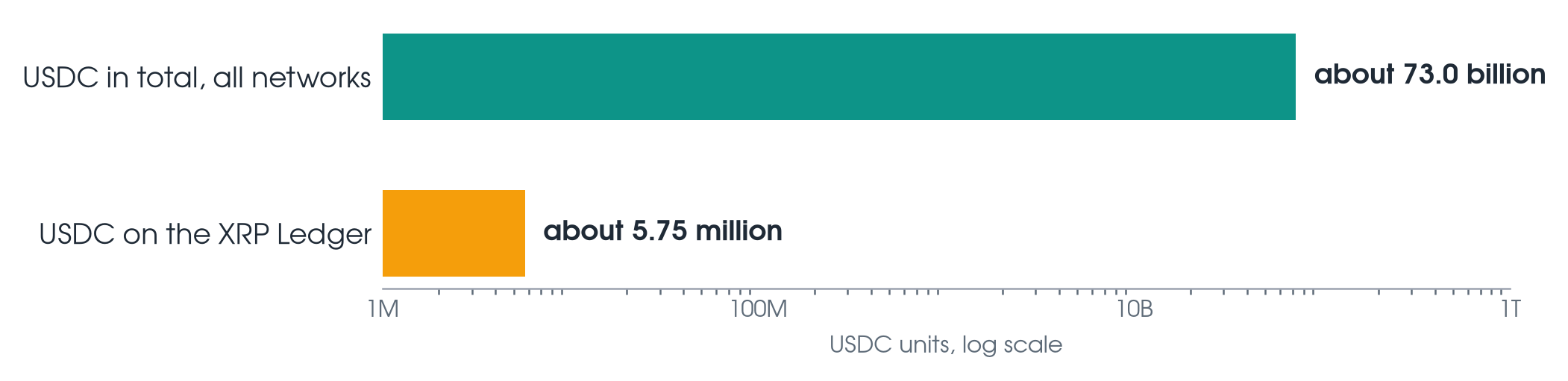
Source: [11] Circle public stablecoin supply endpoint (api.circle.com/v1/stablecoins), fields 'USDC totalAmount' and chain 'XRP', as of 2026-10-10 20:29Z (3:29 PM CT); point-in-time live figure. Data: USDC total 72,998,384,947 (about 73.0 billion); USDC on the XRP Ledger 5,754,616.54 (about 5.75 million). Log scale so both values are visible.
2. How reserves and attestations work
The rules for RLUSD's issuer come from an NYDFS industry letter dated June 8, 2022. It requires the reserve's market value to be at least equal to all outstanding tokens at the end of each business day, keeps reserve assets segregated from the issuer's own, and limits them to short-term Treasury bills, overnight Treasury repo, government money market funds and bank deposits. Holders must be able to redeem at par, and 'timely' means no more than two full business days after a compliant redemption order. An independent U.S. CPA must examine the reserve at least once a month under AICPA standards [7]. Ripple says RLUSD's monthly reports are prepared under that guidance and published no more than 30 days after month end [4].
Circle discloses USDC reserve holdings weekly and obtains monthly third-party assurance from a Big Four accounting firm that reserves exceed USDC in circulation, under AICPA attestation standards [8]. The majority of the reserve is in the Circle Reserve Fund (USDXX), an SEC-registered 2a-7 government money market fund; the rest is mostly cash at large banks [8].
Read an attestation for what it is. Both August 2026 reports are examinations of management's assertion at two report dates, and the accountant's opinion covers those dates [5][9]. They do not describe the days in between, which is why the monthly cadence matters. For RLUSD, coverage was 105.2% as of Aug 31, 2026, per the issuer's monthly reserve report [5].
Exhibit 3. Tokens outstanding vs. reserves at the August 31, 2026 report date
| Stablecoin | Tokens outstanding | Reserve value (USD) | Reserve minus tokens (USD) | Coverage |
|---|---|---|---|---|
| RLUSD | 2,325,969,308 | 2,446,312,864 | 120,343,556 | 105.2% |
| USDC | 73,320,757,305 | 73,398,532,613 | 77,775,308 | 100.1% |
Source: [5] RLUSD Reserve Report (the issuer's monthly reserve report), August 31, 2026, 5:00pm ET; [9] USDC Reserve Report, August 31, 2026, 11:59pm UTC. Note: Coverage = reserve value ÷ tokens outstanding; difference = reserve value − tokens outstanding. One token is treated as one U.S. dollar of liability, as both reports do.
Exhibit 4. RLUSD holds mostly T-bills directly; most of USDC's reserve sits in a government money market fund
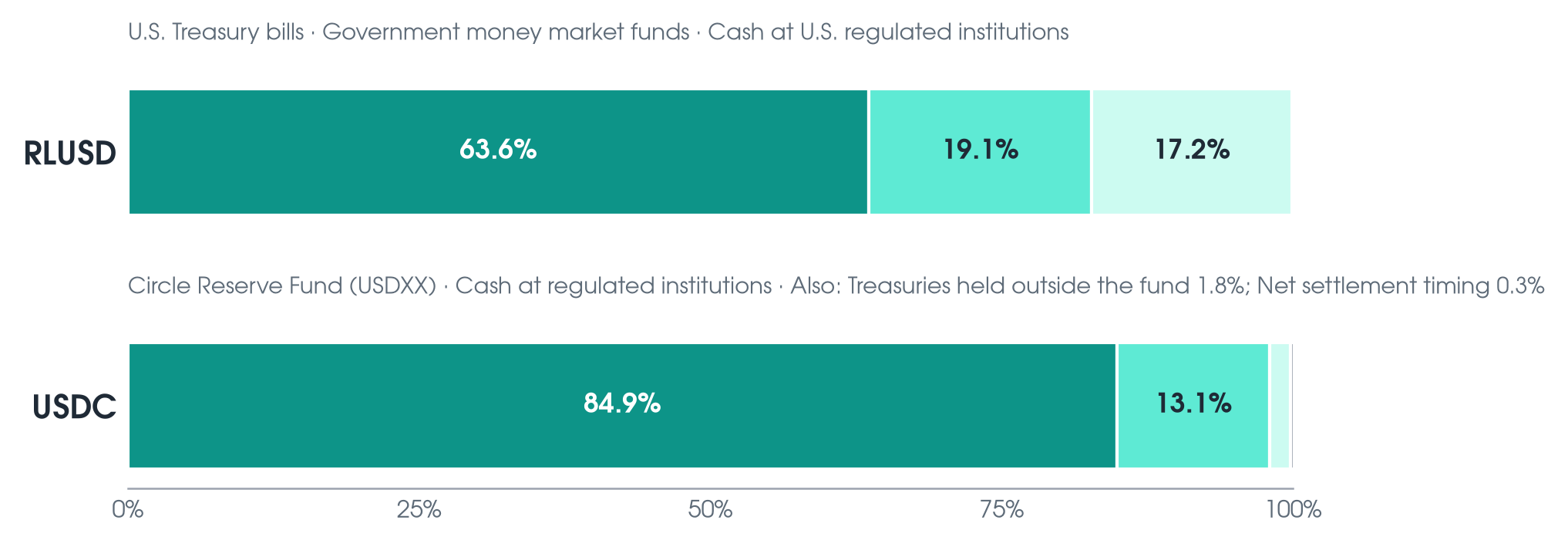
Source: [5] RLUSD Reserve Report, asset-class table, as of August 31, 2026 (5:00pm ET); [9] USDC Reserve Report, Circle Reserve Fund and Other USDC reserve assets, as of August 31, 2026 (11:59pm UTC). Data: RLUSD T-bills 63.6%, government money market funds 19.1%, cash 17.2%; USDC Circle Reserve Fund (USDXX) 84.9%, cash 13.1%, Treasuries held outside the fund 1.8%, net settlement timing 0.3%. Share = line item ÷ total reserve ($2,446,312,864 RLUSD; $73,398,532,613 USDC). Inside the Circle Reserve Fund, Treasury repurchase agreements were $49,584,000,000 (67.6% of the USDC reserve) and Treasury securities $11,918,146,195 (16.2%).
3. Settlement on the XRP Ledger
Trust lines first. RLUSD and USDC on XRPL are trust line tokens. A trust line enforces the rule that nobody can make you hold a token you don't want; each side sets a limit, which is 0 by default [12]. In practice, your wallet needs a trust line for RLUSD or USDC before it can receive them, while XRP needs none [2].
Reserves and costs. Every XRPL account keeps a base reserve of 1 XRP, plus an owner reserve of 0.2 XRP for each object it owns, trust lines included; XRPL.org also describes an exception for an account's first two trust lines [13]. A standard transaction must destroy at least 10 drops, or 0.00001 XRP, and that cost can rise when the network is busy [14][15].
Speed and finality. XRPL.org says validators agree on the order and outcome of transactions within a few seconds [16][17]. A successful payment is final when it is included in a validated ledger [18], and Xaman notes that no one can reverse an XRPL transaction once it is recorded [24].
Check what arrived. XRPL.org warns that a payment's Amount field is not always what was delivered: partial payments can deliver less, so integrations should read the delivered_amount field instead [19].
Exhibit 5. XRPL settlement parameters that matter for invoicing
| Parameter | Value | Source |
|---|---|---|
| Ledger agreement interval | A few seconds | [16] About; [17] What is the XRP Ledger? |
| When a payment is final | When included in a validated ledger | [18] Finality table |
| Minimum transaction cost | 10 drops = 0.00001 XRP (can rise under load) | [14] Current Transaction Cost; [15] XRP Amounts |
| Base reserve per account | 1 XRP | [13] Base Reserve and Owner Reserve |
| Owner reserve per trust line | 0.2 XRP (first-two-trust-lines exception applies) | [13] Base Reserve and Owner Reserve |
| Default trust line limit | 0 | [12] Structure |
Source: XRPL.org pages listed, accessed 2026-10-10.
4. How UrsaDeFi handles it
UrsaDeFi (www.ursadefi.com) is an XRPL invoicing app. Users bill in USD; clients pay in RLUSD by default, and USDC or XRP are also accepted. Fees: 1% platform fee, no minimum fee, and invoices must be at least $25. Sign-in is with Xaman. Payers paying from an exchange use destination tags. [1][2]
The live site adds the mechanics [1][2]. The fee is 1% of the service amount, rounded to the cent, and the $25 minimum applies to the service amount before the fee. Your client pays you the invoice total, which is the service amount plus the 1% fee; you then send the 1% fee to UrsaDeFi as a separate XRPL payment signed in Xaman, in RLUSD by default, and net the service amount. Payments go wallet to wallet to the address on your invoice, and UrsaDeFi doesn't receive your keys. The amount and destination come from the stored invoice, not from anything the payer types. UrsaDeFi marks an invoice paid automatically once the payment appears in a validated ledger transaction. You can also mark an invoice paid by hand; a manually marked invoice still owes the 1% fee [2].
If a client pays in XRP, the XRP amount is worked out from a live XRP/USD price when the payment request is created; if no live price is available, UrsaDeFi refuses the XRP payment and suggests RLUSD or USDC [2]. That matters because XRP's value is set by the open market, unlike a dollar stablecoin [3].
Exhibit 6. Your client pays you the service amount plus 1%; you then send the 1% fee to UrsaDeFi and net the service amount
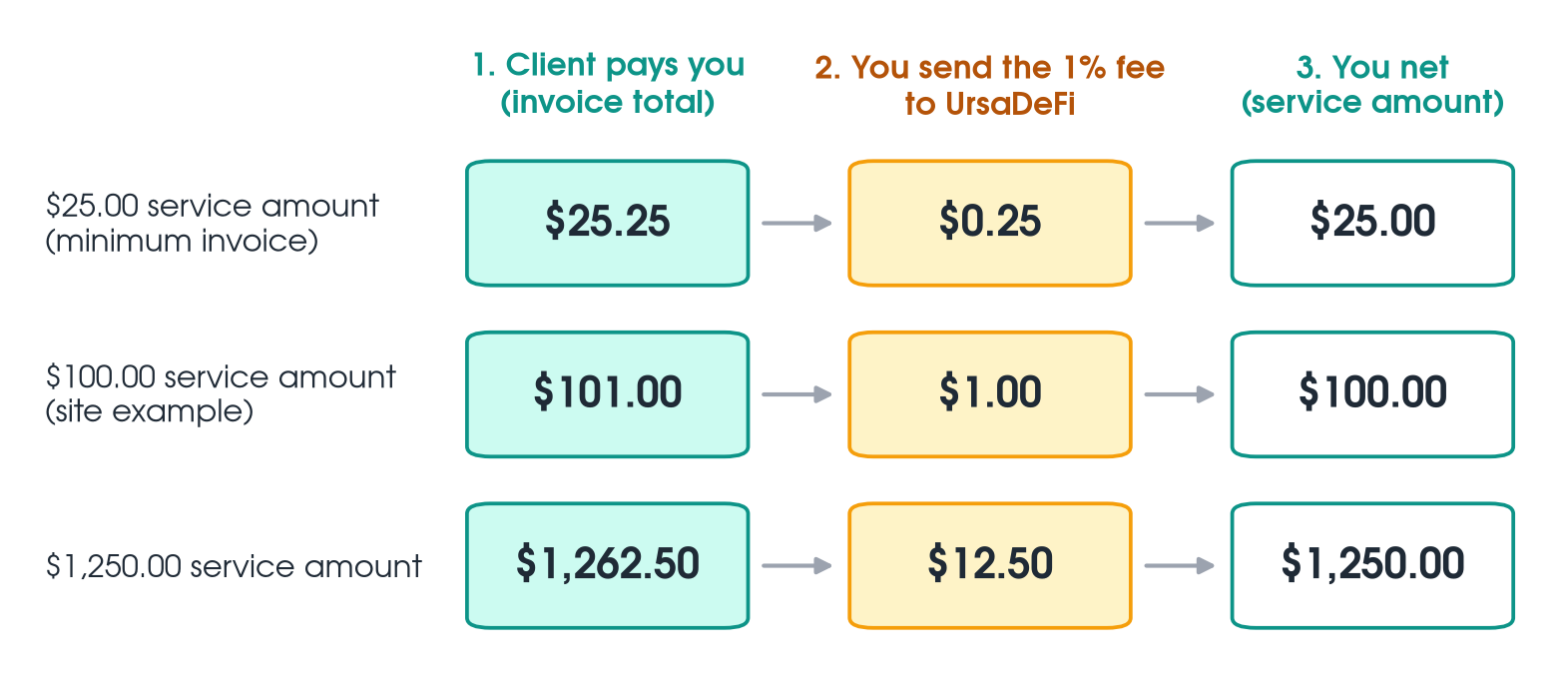
Source: [2] UrsaDeFi FAQ, 'How much does UrsaDeFi cost?' and 'Who pays the 1% fee?', as of 2026-10-10 (accessed). Rule: 1% of the service amount, rounded to the cent, no minimum fee, $25 minimum invoice. Step 1 goes wallet to wallet to the address on your invoice; step 2 is a separate XRPL payment you sign in Xaman, in RLUSD by default. The $100 case is the site's own example; the others apply the same rule. Data (USD), in order: client pays you $25.25 → you send $0.25 fee to UrsaDeFi → you net $25.00; client pays you $101.00 → you send $1.00 fee to UrsaDeFi → you net $100.00; client pays you $1,262.50 → you send $12.50 fee to UrsaDeFi → you net $1,250.00. XRPL transaction costs (Exhibit 5) are not included.
5. What records exist
This section describes records, not tax treatment. The IRS says that anyone with digital asset transactions should keep records documenting each receipt, sale, exchange or other disposition, and the fair market value in U.S. dollars of digital assets received as payment in the ordinary course of a trade or business [20]. Its FAQs state that digital assets received for services are ordinary income equal to their fair market value in U.S. dollars when received [21], and that taxpayers must keep records sufficient to support the positions on their returns [21].
On broker reporting, the IRS digital assets page says brokers report gross proceeds on Form 1099-DA for transactions on or after January 1, 2025, and basis for certain transactions on or after January 1, 2026; the final regulations do not cover non-custodial brokers that never take possession of the assets [20]. The 2026 instructions add an optional method for qualifying stablecoins, under which a broker need not report a customer's designated stablecoin sales of $10,000 or less a year, and a $600 de minimis for payment-processor sales [23]. The IRS 'About Form 1099-DA' page lists the current form and recent changes [22]. Whether any of this applies to you is a question for your tax professional.
Exhibit 7. Records an UrsaDeFi payment leaves behind
| Record | Where it lives | What it shows |
|---|---|---|
| Invoice | UrsaDeFi | USD service amount and line items; asset requested [1] |
| Client payment | XRP Ledger (validated transaction) | Asset, delivered amount, destination, ledger and time [18][19] |
| XRP quote (XRP invoices only) | UrsaDeFi payment request | XRP amount set from a live XRP/USD price at request time [2] |
| Fee payment | XRP Ledger (separate transaction) | 1% fee sent to UrsaDeFi, RLUSD by default [2] |
| USD value at receipt | Your books | IRS asks for fair market value in U.S. dollars [20] |
Source: As cited in each row, accessed 2026-10-10.
Sources
- UrsaDeFi, 'UrsaDeFi: XRPL invoicing in US dollars, RLUSD by default,' https://www.ursadefi.com, section 'How UrsaDeFi works'; accessed 2026-10-10.
- UrsaDeFi, 'UrsaDeFi FAQ: fees, Xaman sign-in and XRPL payments,' https://www.ursadefi.com/faq, sections 'Which assets can I get paid in?', 'How much does UrsaDeFi cost?', 'Who pays the 1% fee?', 'Is there a minimum invoice amount?', 'Does UrsaDeFi hold my funds?', 'How does my client pay an invoice?', 'How does UrsaDeFi know an invoice is paid?', 'If my client pays in XRP...', 'Do I need a trust line?', 'Does UrsaDeFi give tax advice?'; accessed 2026-10-10.
- Ripple, 'RLUSD: The USD Stablecoin for Institutions,' https://ripple.com/solutions/stablecoin/, sections 'Why institutions choose RLUSD' and 'RLUSD FAQs'; accessed 2026-10-10.
- Ripple, 'Transparency,' https://ripple.com/solutions/stablecoin/transparency/, section 'Attestations'; accessed 2026-10-10.
- Standard Custody & Trust Company, LLC, 'RLUSD Reserve Report, August 2026' (Independent Accountant's Report by Deloitte & Touche LLP, Sept. 29, 2026), https://cdn.sanity.io/files/ior4a5y3/production/4981331c98a2bb203c0c9ab2584e8b2a0da80938.pdf, sections 'Management's Assertion' and 'RLUSD Reserve Report'; report dates Aug. 17 and Aug. 31, 2026; accessed 2026-10-10.
- Ripple Docs, 'RLUSD token addresses,' https://docs.ripple.com/products/stablecoin/overview/token-addresses, section 'For XRPL'; accessed 2026-10-10.
- NYDFS, 'Industry Letter – June 8, 2022: Guidance on the Issuance of U.S. Dollar-Backed Stablecoins,' https://www.dfs.ny.gov/industry_guidance/industry_letters/il20220608_issuance_stablecoins, sections 1 (Redeemability), 2 (Reserve), 3 (Attestations); accessed 2026-10-10.
- Circle, 'Transparency & stability,' https://www.circle.com/transparency, sections 'Monthly assurance and transparency' and 'How we manage USDC'; accessed 2026-10-10.
- Circle Internet Group, Inc., 'USDC Reserve Report, August 2026' (Independent Accountants' Report by Deloitte & Touche LLP, Sept. 29, 2026), https://6778953.fs1.hubspotusercontent-na1.net/hubfs/6778953/USDCAttestationReports/2026/2026%20USDC_Examination%20Report%20August%2026.pdf, sections 'Management's Assertion', 'Circle Reserve Fund Assets' and 'Other USDC Reserve Assets'; report dates Aug. 11 and Aug. 31, 2026; accessed 2026-10-10.
- Circle Developer Docs, 'USDC contract addresses,' https://developers.circle.com/stablecoins/usdc-contract-addresses, mainnet table, row 'XRPL'; accessed 2026-10-10.
- Circle, public stablecoin supply endpoint, https://api.circle.com/v1/stablecoins, fields 'USDC totalAmount' (72,998,384,947) and chain 'XRP' (5,754,616.54), updateDate 2026-10-10T20:29Z (3:29 PM CT).
- XRPL.org, 'Trust Line Tokens,' https://xrpl.org/docs/concepts/tokens/fungible-tokens/trust-line-tokens, section 'Structure'; accessed 2026-10-10.
- XRPL.org, 'Reserves,' https://xrpl.org/docs/concepts/accounts/reserves, section 'Base Reserve and Owner Reserve' (current Mainnet values); accessed 2026-10-10.
- XRPL.org, 'Transaction Cost,' https://xrpl.org/docs/concepts/transactions/transaction-cost, section 'Current Transaction Cost'; accessed 2026-10-10.
- XRPL.org, 'Currency Formats,' https://xrpl.org/docs/references/protocol/data-types/currency-formats, section 'XRP Amounts'; accessed 2026-10-10.
- XRPL.org, 'About,' https://xrpl.org/about/, section 'How the Consensus Protocol works'; accessed 2026-10-10.
- XRPL.org, 'What is the XRP Ledger?,' https://xrpl.org/docs/introduction/what-is-the-xrp-ledger, consensus description; accessed 2026-10-10.
- XRPL.org, 'Finality of Results,' https://xrpl.org/docs/concepts/transactions/finality-of-results, result-code finality table; accessed 2026-10-10.
- XRPL.org, 'Partial Payments,' https://xrpl.org/docs/concepts/payment-types/partial-payments, sections 'The delivered_amount Field' and 'Partial Payments Exploit'; accessed 2026-10-10.
- IRS, 'Digital assets,' https://www.irs.gov/filing/digital-assets, sections 'What's a digital asset', 'Keep records', 'Broker compliance'; page last reviewed 02-Sep-2026; accessed 2026-10-10.
- IRS, 'Frequently asked questions on digital asset transactions,' https://www.irs.gov/individuals/international-taxpayers/frequently-asked-questions-on-digital-asset-transactions, Q47, Q57, Q58, Q95; page last reviewed 29-Jun-2026; accessed 2026-10-10.
- IRS, 'About Form 1099-DA, Digital Asset Proceeds From Broker Transactions,' https://www.irs.gov/forms-pubs/about-form-1099-da, sections 'Current revision' and 'Recent developments'; page last reviewed 27-Jun-2026; accessed 2026-10-10.
- IRS, 'Instructions for Form 1099-DA (2026),' https://www.irs.gov/instructions/i1099da, sections 'Qualifying stablecoin', 'De minimis rule for qualifying stablecoin sales', 'De minimis rule for PDAP sales'; page last reviewed 30-Apr-2026; accessed 2026-10-10.
- Xaman Help Center, 'Can Xaman reverse, freeze or undo a transaction?,' https://help.xaman.app/app/all-about-scams/can-xumm-reverse-freeze-or-undo-a-transaction; accessed 2026-10-10.
This post is not tax, legal or financial advice; consult a qualified professional. UrsaDeFi doesn't give tax or legal advice [2].